

Why do I believe this works?
Why this work matters to me:
In all my reading, what strikes me most;
Page 6: Out of the Crisis:
What is the world’s most underdeveloped nation? With the storehouse of skills and knowledge contained in its millions of unemployed, and with the even more appalling underuse, misuse, and abuse of skills and knowledge in the army of employed people in all ranks in all industries, the United States may be today the most underdeveloped nation in the world.
People are entitled to joy in work.
“It ain’t what you don’t know that gets you into trouble.
It’s what you know for sure that just ain’t so.”
Old Theory:
Traditional Management:

This company follows traditional top-down management practices. Leaders determine how the work is to be done and give orders to their staff accordingly. Individuals, functional groups and departments are treated as independent entities under centralized control. Pay and promotion are determined Individual performance according to a set of predetermined criteria. Employees are ranked and encouraged to compete with each other.
New Theory:
Actual Leadership:

Superior companies are managed as an interactive system where people and functional teams depend on each other. Supervisors are not expected to have all the answers. They rely on front line worker’s to share their workplace knowledge and take an active role in improving their work processes. All employees know they are part of a team culture pursuing common goals and solving problems together to move the company forward.
Theory X and Y…
Is it the System or the People?
Most Quality problems are leadership problems:
Quality is not inspected in. It is not enforced by audits. Nor is quality fixed by blaming people.
Quality is made in the process:
Every system produces exactly the results it was designed to produce. If quality varies by person, shift, or mood: The system, not the people, is flawed.
David Garvin gave us multiple ways to define Quality:
- Performance
- Features
- Reliability
- Conformance
- Durability
- Serviceability
- Aesthetics
- Perceived quality
The part CEOs often miss: You are making quality tradeoffs.
Metrics, incentives, handoffs, and priorities quietly teach the organization what actually matters. When speed beats stability, output beats outcomes, or compliance beats learning, quality erodes – by design.
Clients do not experience departments. They experience the entire system.
The real leadership question is not: “Who made the mistake?”
It is: “What in our system made this outcome predictable?”
When Quality is designed into the process:
- Costs fall
- Speed increases
- Trust compounds
- Growth becomes sustainable
Quality is not a goal.
It is a byproduct of a well-designed system.

Lesson in Quality:
UXD (user experience design) POV:
1940s: WWII: Perfect performance by U.S. military is crucial! However,
Pilots were crashing new aircraft at alarming rates. People were suggesting technology had become too advanced for humans. The Air Force studied 4063 pilots. The shocking truth they discovered:
The cockpit, designed for the “average” pilot,
Fit Exactly NO ONE.
Not a single pilot.
Fast forward to today:
Most CEOs think a dashboard of easily manipulated aggregates and blended averages is helping them. But the truth is, it may be blinding them to the real problem (in Quality).
There is a good chance; your organization is NOT user friendly.
There is a better chance; you don’t even know who the real user is.
In other words:
1940s aircraft design was mechanistic. It gave consideration to every working part of the system – except the biological! To the engineers focusing on the jet, the cockpit was an afterthought: Aircraft was NOT user-friendly.
Much like 94% of companies here in the entrepreneurial capital of the world.
(Including aviation service – say some people today)
Can you imagine flying at the speed of sound, maneuvering 9 Gs: Unable to adjust the helmet straps or seat (belt)!
User error was designer error:
Out of the 4063 pilots measured, don’t you think at least 406 of them tried saying something prior? Or 41? At least 4 for Pete’s sake? All to no avail. Why?
It is the system. Not the people.
Quality has to be designed into your process.
Do you know what sparked the American Quality Revolution of the 1980s?
The U.S. had to combat Japanese competition and improve our manufacturing precision. The person leading the charge, was also responsible for the Japanese Economic Miracle:
W. Edwards Deming:
In his bookThe New Economics, For Industry, Government, Education; he shares a quote from Paul Batalden, M.D., 13 November 1990:
“The first step in any organization is to draw a flow diagram. To show how every component depends on others. Then, everyone may understand what his job is. If people do not see the process, they cannot improve it. Anyone needs to see the process as a catwalk, a flow diagram.”
21st Century demands Systems Thinking: That is why we are introducing (AR) Action/ Results maps/ modeling.
User error was designer error:
On Preventing Common Problems:
The theory for transformation from the science of improvement:
To prevent common problems, look at your business through this lens:
SOPK: The System of Profound Knowledge
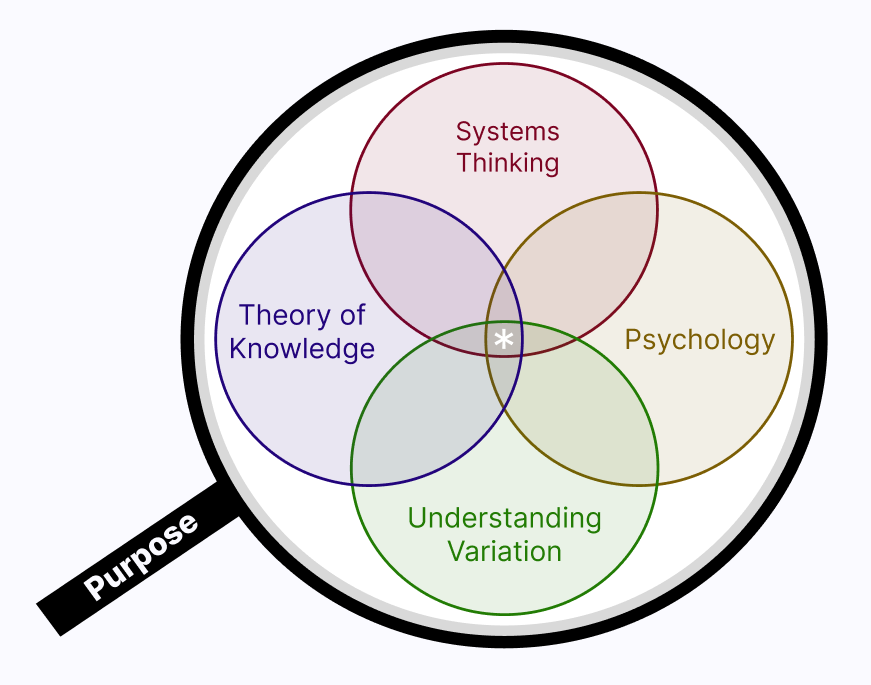
Anyone can do this just by learning more about these four interdependent factors. It will help you in life, getting you closer to the right type of solution faster.
Without SOPK, you are likely to fix either the wrong little thing, and thus miss the big picture aspects of the problem; or you are likely to invest heavily in fixing the entire system when improving a simple little thing is all that was required.
It happens all the time. This can be avoided.
If you study the greatest companies over the last 50 years, they are historically the organizations who have engineered consistent, quality breakthroughs in what I call the “core four.”
- Management
- Innovation
- Marketing
- Strategy
Note how Management is at the top of the list. The first rule of thumb:
The 94/6 Rule, coined by quality management pioneer W. Edwards Deming, states that 94% of workplace problems and performance variations stem from the system (management’s responsibility), while only 6% are attributable to individual employee error.
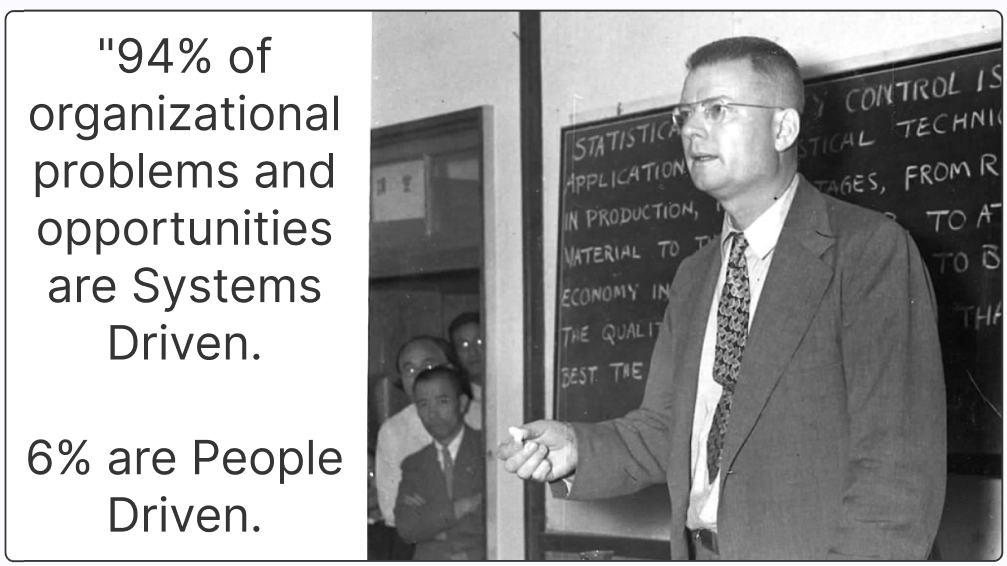
Get the Management foundation right.
The Innovative Marketing Strategies will follow.
If you refuse to learn about Deming’s theory, at least read Dan Heath’s book Reset.
I do a lot of crying about Management.
35 years an employee, I am convinced:
You either tap into intrinsic motivation or stomp it out.
Meet Parker: Contrarian Thinker.
I ask questions many organizations never think to ask:

As a means helping companies under $200M (10-200 people) uncover operational blind spots, map critical processes, and design quality into the system for greater capacity, smoother operations, and more predictable outcomes.
My Philosophy: World-class organizations are those who believe the heart of business is pursuing a noble cause, putting people at the center, and creating an environment where you can unleash human magic.
My Dream: Transformation. Radically improving ourselves as a species: Contributing to the next American Quality Revolution. Sparking dignity, pride and joy in school and work for millions of people:
My Vision: Helping you and some of your friends in our community unleash the chain reaction below – quietly, with low effort.
My Purpose in life is to find a better way and share it. I do this by thinking differently and challenging the status quo. Ultimately I bring a right way of getting predictable results.
My Mission: Make your business a little more world-class than it is today through a simple 8-9 hour workshop.
The vision above: The chain reaction below: It works like this:
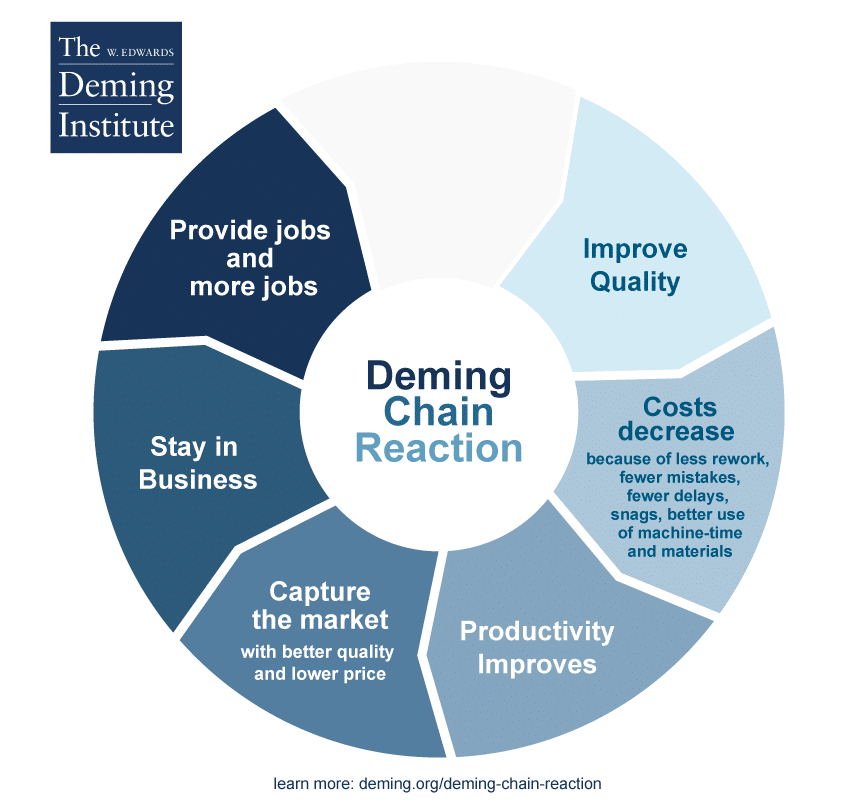
Note: Improving quality (of a product or service) does not necessarily mean producing higher quality or grade. It means Continually Improving THE PROCESS so that the consumer may depend on the uniformity of a product and purchase it at a low cost.
Improvement defined as “Changing how the work is done: Producing visible, positive differences (relative to historical norms and through relevant measures) sustained into the future.”
I work referral-preferred with those who suspect their growth is being constrained by system design — not effort.
Most of my work begins with a quiet introduction. If someone you trust thinks this conversation is worth having, I am happy to connect. What I do;
I help businesses reduce (operational) friction and increase (scalable) capacity by improving the systems behind the work.
If you are CEO or founder, when ready to begin:
My strategy:
(Diagnosis) America is steadily declining. Because we have backwards management philosophy. We treat people (employees and clients) like commodities. This makes Quality and Innovation virtually impossible.
(Guiding Policy) Dr. W. Edwards Deming’ system of profound knowledge gets right at the root cause of this management problem with a synthesis of systems thinking, scientific knowledge, understanding of variation, human psychology that anybody can do (see image of lens above).
(Coherent Actions) Host M4 Workshops: Map your process. Measure how long it takes. Manage more effectively, by Mobilizing your people. A Method/ Model/ Mechanism for continual improvement.
Unless you object to the idea of preventing problems? For example;
I discovered this parable floating around Charlottesville years ago:
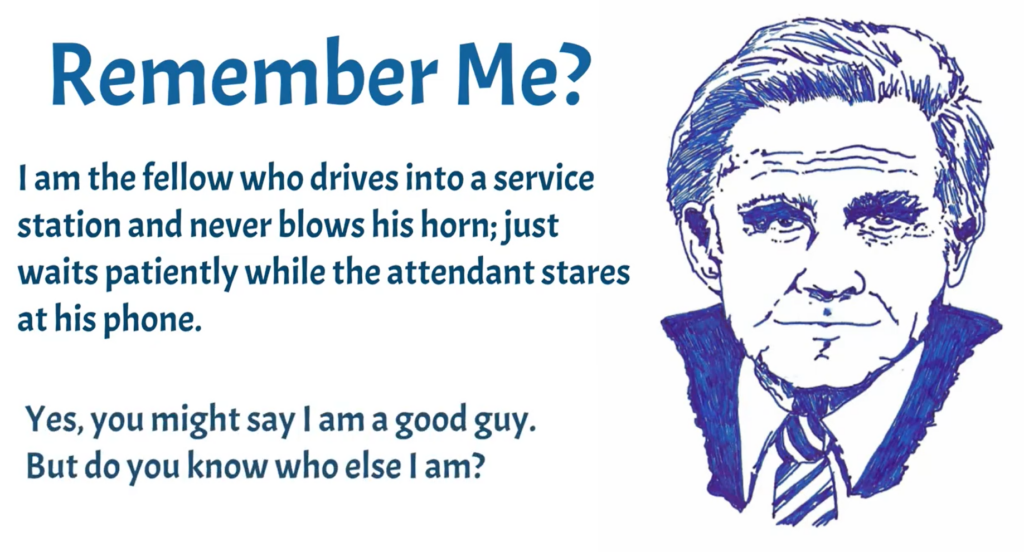
I am The Customer Who Never Comes Back! And it amuses me to see you spending thousands of dollars every year to get me into your store, when I was there in the first place. All you had to do was Show Me a Little Courtesy.
Why not prevent these types of problems?
I can help,
The Contrarian Thinker
P.S. According to Cognitive Scientist Daniel Willingham in David Epstein’s newest book:
“Contrary to popular belief, the brain is not designed for thinking. It is designed to save you from having to think. Because the brain is naturally inclined to avoid effortful thinking and to rely instead on familiar patterns, complete freedom tends to lead to unoriginal ideas. Simply repeating what is known.”
(This is “Business as Usual.” It is also why I suggest ‘bounded’ autonomy…)
People leave companies because of bad management, chaos, money…
Everyone suffers.
We solve these problems.
Where to go next:
Is better to remain silent and be thought a fool,
or speak out and remove all doubt?
In the off chance you enjoy the writing, here is more.
Links outside this website:
(LinkedIn)
Links outside this page:
(Library)
In word and deed do top managers honor the dignity of employees, and the value of their ideas?
Why use maps? They predate spoken language. Unless you show me your system?
Where disaster strikes. Why our model is wrong:
A few concerns for the rational, logical, tool-making, knowledge-acquiring individual with the proclivity to leverage more than 20% of their assets (human, intellectual, financial, and otherwise):
Would a buyer pay a premium for your business?