

What have other people taught me?
One (1) minute watch:
Many people say this NBC special sparked the American Quality Revolution.
It certainly upended how the U.S. and world saw business and industry:
Warning: You may experience a fascinating, thoughtful, depressing examination of what makes and maintains work ethic in our world today.
Discover why we may end up freezing in the dark. Why the Japanese will not. What we can do about it!
One hour and 17 minute must watch:
Sample the 30k’ overview by Derrick Mains. 32 minutes:
In the clip above, he discusses the historical context of World War II and its impact on American manufacturing and leadership. He highlights the critical role played by W. Edwards Deming in streamlining American manufacturing during the war effort. Deming emphasized statistical control and employee empowerment as key drivers of success. The speaker discusses the unique circumstances during the war, where executives had to work closely with frontline workers due to the absence of middle managers, leading to a more collaborative and efficient system.
Explores how the integration of statistical control and employee empowerment led to significant advancements in American manufacturing during the war. Contrast Deming’s approach with the command-and-control style of management advocated by figures like Jack Welch. Derrick emphasizes the importance of focusing on systems and processes, as highlighted by Deming, who attributed 94% of business problems to system failures rather than individual errors.
If you study the greatest companies over the last 50 years, they are historically the organizations who have engineered consistent, quality breakthroughs in these four areas I call the Core Four:
- Management
- Innovation
- Marketing
- Strategy
Starting with Management, the first rule of thumb:
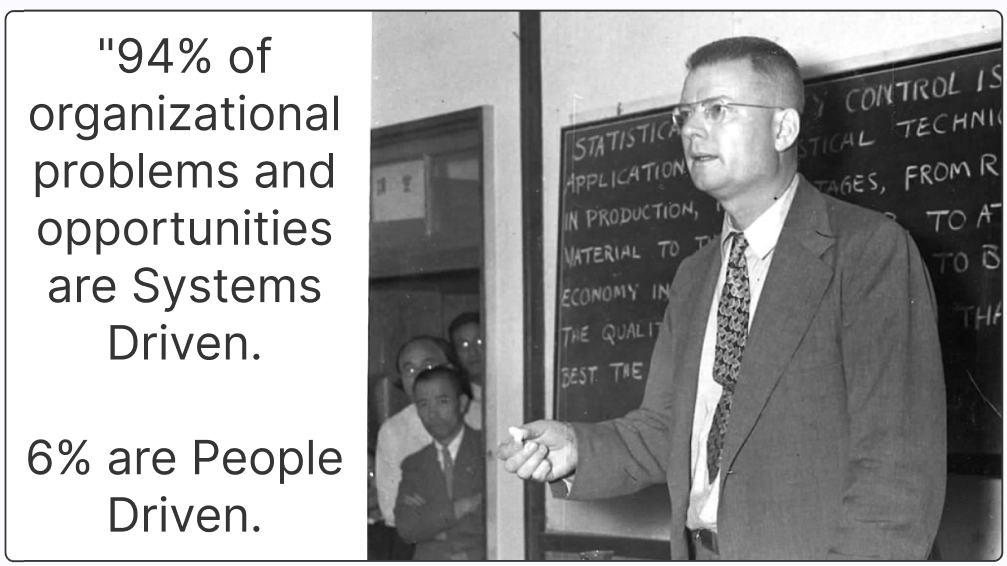
The 94/6 Rule, coined by quality management pioneer W. Edwards Deming, states that 94% of workplace problems and performance variations stem from the system (management’s responsibility), while only 6% are attributable to individual employee error.
They say the best marketing strategies are referral, word of mouth, social proof… Get the Management foundation right. The Innovative Marketing Strategies will follow.
What does quality management look like?
At Apple, it is rumored they say:
Why?
For over 80 years, the Western ideology of management has dominated the way that you and I think about our businesses. The reality is, it is fundamentally and functionally incorrect. We spend almost all of our time trying to manage people, trying to manage events, trying to psycho-manipulate behaviors. We do not focus on the structure. We do not have a process map that shows us how to get through from point A to point B. We are not having conversations with the seeds (employees) asking what is standing in your way? We are not going to where the seeds have been sown. Instead we are looking at the pests and diseases while ignoring the soil (the people). We are standing on the side saying I planted those seeds six (6) months ago, why haven’t they performed according to these KPIs? I need to tear all those seeds out and throw them away. NO! We have to understand the conditions in which the work is being done, and improve THOSE conditions.
Again, it is has been scientifically proven that 94+% of all problems are the systems by the greatest statistical thinker in the last 2000 years. Now, think about how you and your employers spend their time: When trying to improve your people, you are working on the 6%. Meaning the best you can do is make a small difference… This results in the most insignificant impact (6%). How often do you (or they) work on the systems? Maybe 6% of the time you spend working on the issues that have the largest impact?
“Exactly backwards”
If 94% of all the problems in your business are the result of a system that has been poorly designed, how much of your time are you spending on that? If you are like 90% of the CEOs I know, NONE. You have never spent a moment thinking about the systems. And systems process only comes in two forms: Evolution or mutation. In the void, we need to get things done. Quantity over quality. A focus on output. Or, are you creating processes through intelligent design? With consistent, constant analysis of what is occurring in the system? Designing and implementing new tools, methods, procedures, policies and best practices that resolve recurring issues? Unless you are spending 94% of your time on systems and processes inside your organization, according to the father of process improvement, you are doing it all wrong. How do you solve any problem? Process mapping is a really important part. We have to understand what the process is. Some call for SOPs: Making it easier to train and enforce: This is the old style of management. Once you see it, you cannot unsee it: The system broken. It has a ton of garbage in it. Waste is omnipresent. To top it off, executives have no idea “how the sausage is made.” Their methodology is to sit down with their managers and have them write out what the process is, making this their standard operating procedure. Do you see the fatal flaw with this?
This is the exact opposite of what you should do inside your business. Never documenting anything until you have gone through it with a fine-tooth comb, working with the people in the process, extracting their pain from that, coming up with solutions, resolving those things, creating a more efficient pathway, then and only then do we want to document SOPs, which should be somewhat loose because we should be auditing processes continually, annually at least. It is critical to go back and identify the new problems that have come in. A broken bottleneck creates something else downstream… Focus on the process. Not the people. Most employees have no voice. Are we allowed to voice concerns, choose where to sit, what to wear, when to work…?
94% of all problems are the systems: If you are trying to improve the people, you are working on the 6%. You are working on the thing that is going to have the smallest difference. That is going to make the smallest amount of impact.
How often do you work on the systems?