

Your employees CANNOT tell you the truth.
This leads you to managing a distorted version of reality.
Just like you cannot tell us the truth, we cannot tell you the truth.
How then, can we truly innovate, optimize or improve as an organization?
With lack of trust and fear, how can your company reach its potential?
When employees do not feel safe telling the truth, leaders end up managing a distorted version of reality instead of the real problems, risks, and opportunities.
This blinds the organization, causing poor decisions, growing waste, stalled innovation, and the quiet loss of good people.
This is unpolished, a bit rambly and genesis to the dagger piercing my limbic system (where I struggle to find words/ language/ expression to convey both the problem (ass backwards management theory) and its solution (M4 process).
The first two lines above say it all. What follows is me telling story how my former boss was telling me how to do my job without knowing how to do my job. After questioning his integrity, I am hoping it is obvious that you in fact managing a distorted version of reality, if you operate in our traditional manner.
For what it is worth, my boss was a great guy. Fun to be around. People like him. He is just dumber than fuck as a leader. Sociopathic. Akin to Bernie Madoff.
Also, my former most despised bosses, always had great intentions. So, This is not about people. It is about systems. And the (to me) glaringly obvious fucking gap between internal and external reality that the seer is oft oblivious to.
One reason may be CEOs and founders and CEOs unknowingly incentivizing people to lie to them. The “Great” Peter Drucker touts MBO (management by objective) “By any means necessary. Whatever it takes. Just get me results.”
Okay Bozo, to secure our livelihood, we will comply.
Keep your eyes on your dashboard, for the latest in blended averages…
But, is that good for the organization?
Stop reading here.
You are not short on Talent. Your talent (human capital/ people) are restricted from contributing. Value is lost. If you cannot see it, allow me to show you.
The gist of this post: Fear is bad. It is always present. This is bad for you. Bad for everyone. It is not PC to be honest. How can you accurately assess any situation?
Most performance problems are designed into the system. I can do something here. I can help you See – and fix – that design.
What follows is a long-winded story that I may end up deleting because I keep running off on tangents…
This begins my running thinking pad:
Take 2: The origin story of the “Management Rebel”
Still employed
Trapped
Suffer or Quit
These were my only two options
Until
Top Management provided an appreciation survey
When being mistreated – what better time to “complain”
20 minutes later an armed detective escorts me out the building
Just one story in a trillion
Welcome to City Hall
We may live in a Democracy
We do not work in one
If we cannot trust you, be honest, allowed to contribute,
How in the hell can we truly innovate, optimize or improve as a nation?
When unable to contribute:
What is the point?
What then?
Sabotage? Malicious compliance? Suck it up? Hussle? Show flare? Be a Yes man? Climb the corporate ladder? Make fun? Play nice?
With the genius use of sticks and carrots,
Why don’t we just say:
“The beatings will continue until morale improves!”
Suffer or Quit: I could transfer. I have, many times, to various industries, in various roles, and one thing remains the same, as an American employee (alone and lost in a networking world), there is no where to run. Boeing had a cool thing in the 90’s. Many companies do. Many More do not. So, having exhausted all my pleas for a grain of autonomy, I sought the help of HR. Why not? Human resources. Email J they say. Well, you can see how that went. For what purpose? Was that good for the organization? Did taxpayers benefit? Did our department improve? Why drive fear into the organization? Do you know why Robert Greene wrote the 48 Laws of Power? “Put three people together and politics and egos take over. The person with the power and leverage tends to go as far as they can with it.” Pinche bullies. Good for nuthin
Take 1: The origin story of the “Management Rebel”
Conceived immediately following the Future Supervisors course. Creating and Office of Excellence was a real winner too. When all the Commissioners got together, I heard some real bad ideas… Traditional. Rational. Logical. Ideas. What got me:
Honesty and Speaking Up:
Turns out that is not what the City Manager was seeking in his employee appreciation survey.
We live in Democracy. (Thank god. Let’s keep it that way). However, I assure you,
We do not Work in one.
As a result,
Your employees CANNOT tell you the truth.
20 minutes after asking to work from home I was escorted out the building by an armed detective. Consider this my creative demonstration as to how and why:
You are managing a distorted version of reality.
Or maybe you’re humming that Rolling Stones song Get off of my cloud?
Is it really that hard to believe most everything we know and do in management and operations is exactly backwards? So 1850’s. Somewhat advanced from slavery, yet we still
Treat people like garbage. Using carrots and sticks (rewards or punishment), starting in school, to “motivate” them. Train and enforce. What if there were a better way? Bias of status quo:
Without a psychological safety net, how can we possibly help you fulfill your vision? How can any organization truly and masterfully innovate, optimize, or improve?
Are you familiar with the stages of truth? Like Bruno or Galilei, I am over here thinking, hey dumbass, do we (you and your employees) even share a common aim? (We did not. We had people working against one another in our tiny subsection of a department. There was nothing we could do about it. Expand that out to the other departments. Damn.
Now, I know full well my only duty is to obey the wishes of Commissioner/ Commander. In this situation, I suffer daily rework or quit. How pointless is that? No purpose. No drive. Nada
CEO: Are you certain about that distortion of reality?
Maybe you are questioning mine?
First: A gentle dose of reality about your workplace honesty, from ChatGPT:
Why Employees Cannot Tell Employers the Truth — and How It Hurts the Organization
Why employees don’t tell the truth
Even in “open-door” cultures, employees often stay silent or sugarcoat reality because:
- Fear of negative consequences
They worry about losing their job, damaging their reputation, being labeled “difficult,” or being excluded from opportunities. - Power imbalance
The employer controls pay, promotions, evaluations, and job security. That imbalance automatically suppresses candor. - Past retaliation (direct or indirect)
People remember when someone spoke up and it went badly. That memory lasts years. - Leaders unknowingly discourage honesty
Interrupting, defending, explaining, or dismissing concerns trains employees to stay quiet. - Cultural norms
“Don’t make waves,” “just do your job,” and “that’s above your pay grade” suppress upward feedback.
How this harms the organization
1. Leaders manage illusions instead of reality
When the truth is filtered, problems appear smaller, progress looks better, and risks look lower than they actually are. Result: Decisions are made on bad data.
2. Problems grow silently
Small issues that could have been fixed cheaply become expensive, urgent crises because no one wanted to “bring bad news.”
3. Waste becomes normal
Inefficiencies, broken processes, and customer complaints get hidden. Leadership thinks the system is fine while the front line knows it isn’t. This is exactly what Deming warned about:
“Management is prediction. You cannot predict without data. And you cannot get data if people cannot speak.”
4. Innovation dies
No one volunteers new ideas when it feels unsafe. Creativity collapses in environments where “don’t get in trouble” is more important than “improve the system.”
5. Good employees disengage (or leave)
High performers hate pretending everything is okay. They leave quietly, while complacent or fearful employees stay.
6. Trust erodes
Whether leaders know it or not, employees talk—to each other. When they don’t trust leadership with the truth, an “underground culture” forms.
7. Leaders lose the only perspective they cannot generate themselves
Executives can see strategy and numbers, but only employees see friction, customer pain points, workflow barriers, and daily realities. If employees will not tell the truth, the organization is blind in the most important direction—upward.
The bottom line:
When employees cannot be honest, the organization cannot learn, cannot adapt, and cannot predict the future.
This is not a “people problem.” This is a system problem, created by leadership behaviors, structures, and incentives.
Fix the system → candor increases → performance improves.
💡 What this really means:
- If employees can truly speak the truth, you’re not just improving “feel-good” culture: you’re likely unlocking a 20–25% productivity gain, based on what’s observed when communication is strong.
- Lower turnover from psychological safety (-41%) means significant savings (recruiting, onboarding, lost institutional knowledge).
- More innovation (- 45% higher odds) can accelerate improvement cycles, new ideas, and competitive advantages.
- Because motivation goes up dramatically (72% more likely to take risks), the organization becomes more adaptable and resilient.
Now, about my story.
What this story is really about, in the words of Robert Greene (48 Laws of Power): “Put three people together and politics and egos take over. The person with the power and leverage tends to go as far as they can with it.”
My question:
Is that best for the organization?
The person with power could, with less effort, design a superior system where the company would flourish long-term. Why not be hero?
Instead of slipping into decline, fighting the same fire over and over, stuck with people who cannot find a better job.
One example:
CEO wanted a NPS (net promoter score) of 80% (ish) It was currently 59%. During the mapping session when AR facilitator brought this up, everyone busted out laughing. The real number was less than 20%. Why?
Because he financially incentivized his people… he married his entire staff to this KPI. All the employees have to do to ensure their livelihood is overlook weaker scores. If you are shaming the employees, Why? Do they really have any control over the system? You know who does, right?
I heard years ago that only 4% of dissatisfied customers bother complaining. How does that translate to employee complaints? Does it really matter? The entire index is a meaningless Average of certain people who respond in a certain way to a certain prompt. Better to control how the data collected than be reminded that the Average person has one testicle. Meaning: most data is Average. Meaningless. Study Deming. Is it possible you have programmed your people to bring you only good news? Pompous much? No wonder. Take a Gemba walk.
My Story:
I wish I could tell you how the lack of trust in the workplace is affecting you. I cannot. All I can do, is assure you the condition is real. Its full effect unknown and unknowable. This is not yet a national crisis. Give it four (4) years.
Setting: As an employee of 35 years, I know with certainty your employees will not be completely honest with you. They simply cannot. Not because of you. Because it has been beaten out of them by every other employer. The process begins as early as age 3.
I am not suggesting or referring to little white lies either. I am talking about what lies downstream of Shit’s creek: Chaos theory, compounded!
Employees are ignored, overlooked, treated like garbage, programmed not to complain. For shame!
Moral of my story:
Where employees cannot be honest;
Improvement, innovation, optimization are virtually impossible.
In all sincerity,
I am somewhat afraid to share this.
It feels childish and immature,
Makes me feel evil and gross
Yet I feel somewhat obligated, because
If my job is to make my boss look good, I failed.
I would have preferred if we were all on the same page, striving to better the organization and continually improve our service to the end user.
I swore an oath to do my best work.
Problem is, the system prevents this from happening.
Speak up, complain, beg, persevere, run away, try a different approach?
Suffer or quit
Truth is, I had no say or authority in anything. To be more precise:
Seems reasonable to estimate I was limited to 6% choice in anything. Certainly no decision making capability relating to tools, equipment, when to show up, what to wear, what to do, how to talk, when to eat, and as I demonstrate: WHERE TO SIT.
All I am asking to do is avoid rush hour traffic, spending 9 hours a day confined to a cubicle in a windowless room in between two chatty cathies when it takes me only 90 minutes to outproduce everyone else putting 40 hours in that position prior.
(“Maniac” Dave was my first mentor. He was efficient. He and Boss had a created a win-win situation. I like efficiency. I like win-win. Problem is, it is impossible with current, traditional, management approach.
The reason we cannot be honest with you, is because I cannot challenge you, and hope to collect a paycheck at the same time.
Homeboy made it clear: Don’t say anything he does not want to hear. Damned be the bearer of bad news.
How can we be efficient, if we cannot be honest with you?
People in my department were/are miserable. Treat people like shit… Like shit rolling downhill, it’s going to get all over the customers. Just thought you should know….
Voice of Employee: I am asking HR to work from home, after exhausting all pleas with my supervisor and boss. If there was ever a time and place to make case, it was here and now.
Result: HR and my boss essentially threaten me (certainly my livelihood). They accused me of violence while literally banning me from the City. While doing this, some skin-headed dude is sitting quietly in the corner not saying a word. He didn’t have to. His Glock 22 said it all.
Funny thing is: This was during an employee appreciation survey held by the City Manager, who, suddenly, I was forbidden to contact. Hmmmm. This is only a fraction of it:
Mind the reality gap here:
According to their fiction:
The City is advocating for employees:
“We want you to work from home”
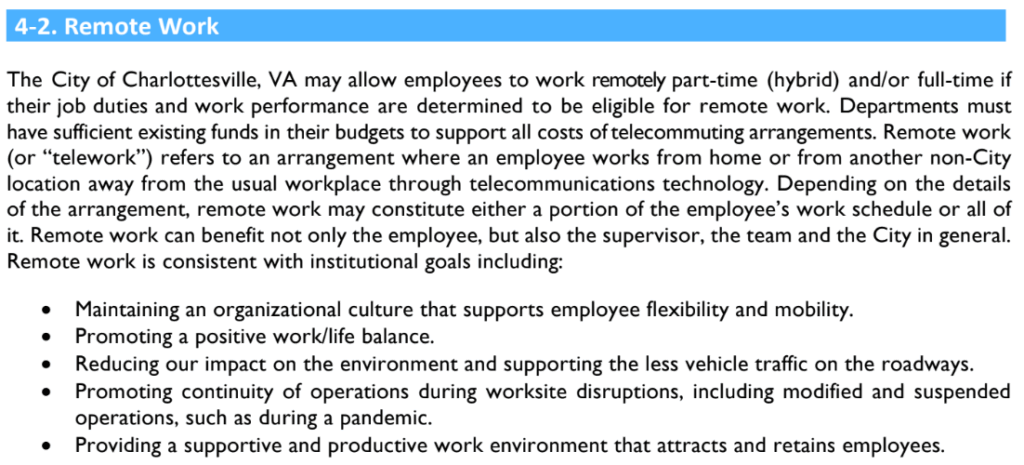
Here they describe the wonderful working environment:
“Welcome to the City of Charlottesville’s Careers page, where we’re dedicated to fostering a community built on Commitment, Integrity, Respect, Innovation, and Collaboration. At the heart of everything we do is our unwavering commitment to Justice, Equity, Diversity, and Inclusion. We believe in creating a workplace where every individual is valued, respected, and empowered to contribute their unique talents and perspectives.
While working with us, you’ll enjoy a tailored compensation package, ongoing training opportunities at all levels, and the chance to perform truly satisfying work in the community in which you live, work, and play. We look forward to you playing a vital part in what makes Charlottesville the dynamic community that it is.
When you work for the City of Charlottesville, you join a thriving city where uniqueness is celebrated, and the environment is a perfect blend of rich history, art, music, food, and recreation. Thank you for considering a career with the City of Charlottesville. We look forward to the possibility of working together to build a brighter future for our city and be a place where everyone thrives.”
However, at the time,
One reason why I am asking to work from home:
City Hall is closed:
I love what she says at 1:33 in video above
I spoke up because I could not believe our circumstances. They were so outlandish I pinched myself hoping to wake up from this tyrannic nightmare.
Check out the Renovations: Some were in our room. Most in the adjacent lobby. The door on the left is our only exit/ restroom access:
My prior job included chimney sweeping. For this reason, I thought to say nothing. However, my coworkers encouraged me to speak up, for this reason. In case you are wondering:
City Hall does have asbestos in it:
My malfunction:
I value calm and quiet and appreciate honesty. Yet,
I am situated between two Chatty Cathies. One of whom has emphysema. Between the acts of God (great toilet leak of ’23), the jackhammering, hazard warnings, militant management, dust and debris, etc.
Mind you: I swore by oath to do my best work.
Silly me: Here I am thinking I am serving my community. In case it is not self-evident: My duties are clear:
I was to serve but one (1) single individual in our community.
Note the time and date, the type of work taking place rather close to that asbestos latent door.
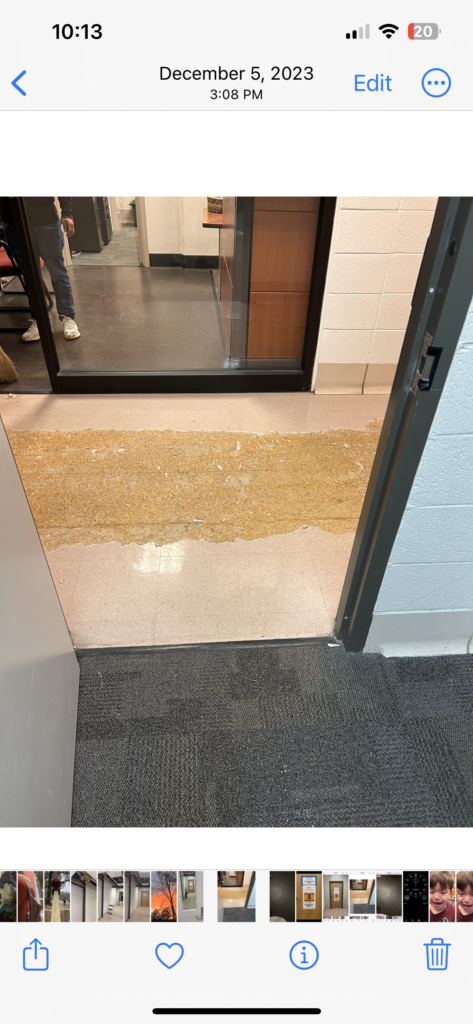
Here is why: Because,
This is when I followed up with HR (human resources and the individual supposedly inquiring through the appreciation survey). Funny thing is,
My supervisor was not present either day. She was working from home.
If you FOIA request the last email I sent as a City employee, I hope and expect you would see something like this:
City Hall closes in 89 minutes (5 pm).
They shut me the fuck up within 21 minutes:
See first paragraph, last sentence: “Due to the…”
Remember, this is the same time the City Manager is sharing an employee appreciation survey.
Normally I say nothing. However, this whole situation was so unbelievable I had to speak up, for myself and my coworkers. Because, after all, they asked!
(Do you still believe most organizations share a common aim?)
Quality in America, wtf. This is why Deming ignorance is so tragic.
I was never perceived as a threat prior to sending that email. That’s why, after a careful investigation, my official termination was over dress code: I thought I needed a hard hat. Turns out, it was a dress shirt.
Yes, that is a jab. How sinister?
Like every other job, I begged for improvement. For years. To no avail. Am I not just requesting basic courtesy? I am the quiet one that never speaks up or makes a fuss. It just seemed like all the stars were lined up…
If there were ever a time for brutal honesty… I said what the hell and took the plunge.
You see wtf happened.
My coworkers now know what to say when they are asked questions. Going forward, paint a pretty picture, keep the veil on, and just let honcho have his way with me. Pun intended.
What did they want? Not statistical control. Not efficiency. Not lowest cost. Not our opinions, suggestions. ‘Be seen, not heard”
Do do my best work? How about an occasional calm, quiet, comfortable environment? What do I know?
I was never invited there to think.
Sorry y’all, as David Letterman says “There is no off position to the genius switch.” Besides, I root for the underdogs. In this case; the employees. Improve their situation and Quality improves, including and especially quality output to the end user (taxpayer, customer, client, etc.) which is the only thing they care about.
I think this word is wrong: Dispergic design: Design which gives consideration to every working part of the system except for the biological component (that’s us).
That is zero sum. Win-lose. Why? A scarcity mindset in the land of abundance. Acting like fucking war lords, I don’t get it.
In the pursuit of happiness (pun on that middle statue affixed to City Hall).
It bothers me. I would rather have transformed that entire organization. Some of the higher ups are quite comfortable with things as they are. Better luck in the private sector?
M4:
- Mapping your process,
- Measuring how long it takes, helping you
- Managing more effectively by
- Mobilizing your people:
Pick package B or C and discover how this log and snail will transform your company into the 21st century excellence:

I Provide: System Clarity, Lasting Change
- Make the invisible system visible
- Identify the true constraint limiting performance
- Surface non-obvious sources of waste and friction
- Clarify where improvement will (and won’t) pay off
I reduce uncertainty so you can invest time, money, and leadership attention where it actually matters.
Who This Work Is (and Isn’t) For:
For:
- CEOs of complex organizations
- Leaders facing cross-functional friction
- Owners preparing for growth, acquisition, or change
Not for:
- Leaders seeking quick fixes
- Teams wanting tactical optimization
- Organizations unwilling to examine management design